Nature-Informed Therapy in Practice: How I’m Bringing Nature Into the Therapy Space
When I first began exploring Nature-Informed Therapy, I knew I wanted nature to become more than the setting for a therapy session.
I wanted to learn how to intentionally bring the natural world into the therapeutic process.
Since becoming a Certified Nature-Informed Therapist, I’ve been experimenting with different ways to incorporate nature, imagery, metaphor, mindfulness, and our connection to the natural world into my work with clients.
Some of these practices happen outdoors.
Others happen virtually, right from a client's own home.
And that has been one of the things I’ve come to appreciate most about Nature-Informed Therapy: it doesn't always require us to physically be outside.
Nature can enter the therapeutic space through an image, a metaphor, a memory, a question, or an invitation to notice our relationship with the natural world.
Here are some of the practices and interventions I’ve been incorporating into my work.
Sensory Grounding
One of the simplest ways to connect with nature is to slow down and notice what is already around us.
During outdoor sessions, I might invite a client to pause and engage their senses:
What do you see?
What do you hear?
What do you feel?
What do you smell?
What do you notice in your body?
This can be particularly helpful when someone feels overwhelmed, anxious, disconnected, or caught in racing thoughts.
Instead of simply telling ourselves to "calm down," we give our attention somewhere to go.
A bird calling from a nearby tree.
The texture of bark.
The movement of leaves.
The temperature of the air.
The feeling of our feet making contact with the ground.
The goal isn't to force relaxation.
It is to create an opportunity to notice what is happening in the present moment.
Sit Spot Practice
Sometimes we walk.
Sometimes we stop.
Sit Spot practice invites a person to spend intentional time in one place in nature without needing to accomplish anything.
This can be surprisingly difficult.
We are so accustomed to movement, productivity, and distraction that sitting still can bring up thoughts like:
"I should be doing something."
"I'm wasting time."
"I don't have time for this."
Those thoughts can become part of the therapeutic conversation.
What happens when you aren't producing?
What do you notice when you stop trying to fix something?
What does your body do when you give yourself permission to simply be?
The natural environment becomes a place to practice presence rather than simply talk about it.
Grounding and Connecting With the Earth
Another practice I’ve incorporated into outdoor sessions is intentionally connecting with the ground beneath us.
Depending on the setting and the client, this may involve standing or sitting with bare feet on the earth, placing hands on a natural surface, or simply becoming more aware of physical contact with the ground.
For me, the therapeutic value isn't about promising a particular physiological outcome.
It is about the experience of intentionally slowing down and connecting with the present moment.
What does it feel like to slow down?
What do you notice when you pay attention to your feet?
What changes when you feel supported by the ground beneath you?
The metaphor can become meaningful, too.
What does it mean to feel grounded?
Where in your life do you feel supported?
What helps you feel rooted when everything around you feels uncertain?
Mindful Walking
Walking has always been an important part of my relationship with nature, so it makes sense that mindful walking has become part of my therapeutic work.
Mindful walking isn't about how far we go or how quickly we get there.
It can be as simple as noticing the rhythm of our steps, our breathing, the terrain beneath our feet, and the environment around us.
Sometimes we slow our pace.
Sometimes we walk in silence.
Sometimes we pause to notice something that catches our attention.
And sometimes the walking naturally creates space for conversation.
There is something about walking side by side that can make difficult conversations feel different.
We don't always have to maintain eye contact.
We can pause.
We can notice the environment.
We can allow a few moments of silence without feeling like we have to immediately fill them.
The trail becomes part of the therapeutic space.
Nature Metaphors
One of my favorite parts of Nature-Informed Therapy is noticing the metaphors that naturally emerge from the landscape.
A client might notice a tree that has grown around an obstacle.
A trail might represent a transition.
A fallen branch might bring up thoughts about letting go.
A river might become a metaphor for movement, change, or releasing something that no longer needs to be carried.
I don't want to impose a metaphor on a client.
Instead, I might ask:
"What does that remind you of?"
"If that tree could represent something in your life, what would it represent?"
"What do you notice about the way this river moves?"
"Where do you see yourself in this landscape?"
The meaning comes from the client.
Nature simply gives us another language for exploring what may be difficult to put into words.
Bringing Nature Into Virtual Therapy
One of the things I’ve learned through this work is that Nature-Informed Therapy doesn't have to stop when a therapy session happens virtually.
Some of the interventions I've been using with clients take place entirely through a screen.
I’ve been finding creative ways to bring nature into virtual sessions through photographs, visual exercises, questions, metaphors, and activities that invite clients to explore their relationship with the natural world.
Eco-Identity Questions
One way I’ve been exploring this is through eco-identity questions.
Our relationship with nature can be deeply personal, even when we don't think of ourselves as particularly "outdoorsy."
I might invite a client to think about questions such as:
What role has nature played in your life?
Where do you feel most connected to the natural world?
Was there a place in nature that was meaningful to you growing up?
What do you notice about yourself when you spend time outside?
What does nature mean to you?
Has your relationship with nature or your access to nature changed throughout your life?
These questions can open conversations about identity, belonging, memories, values, relationships, and even loss.
They can also help clients recognize that their relationship with nature is already part of their story.
Nature-Based Vision Boards
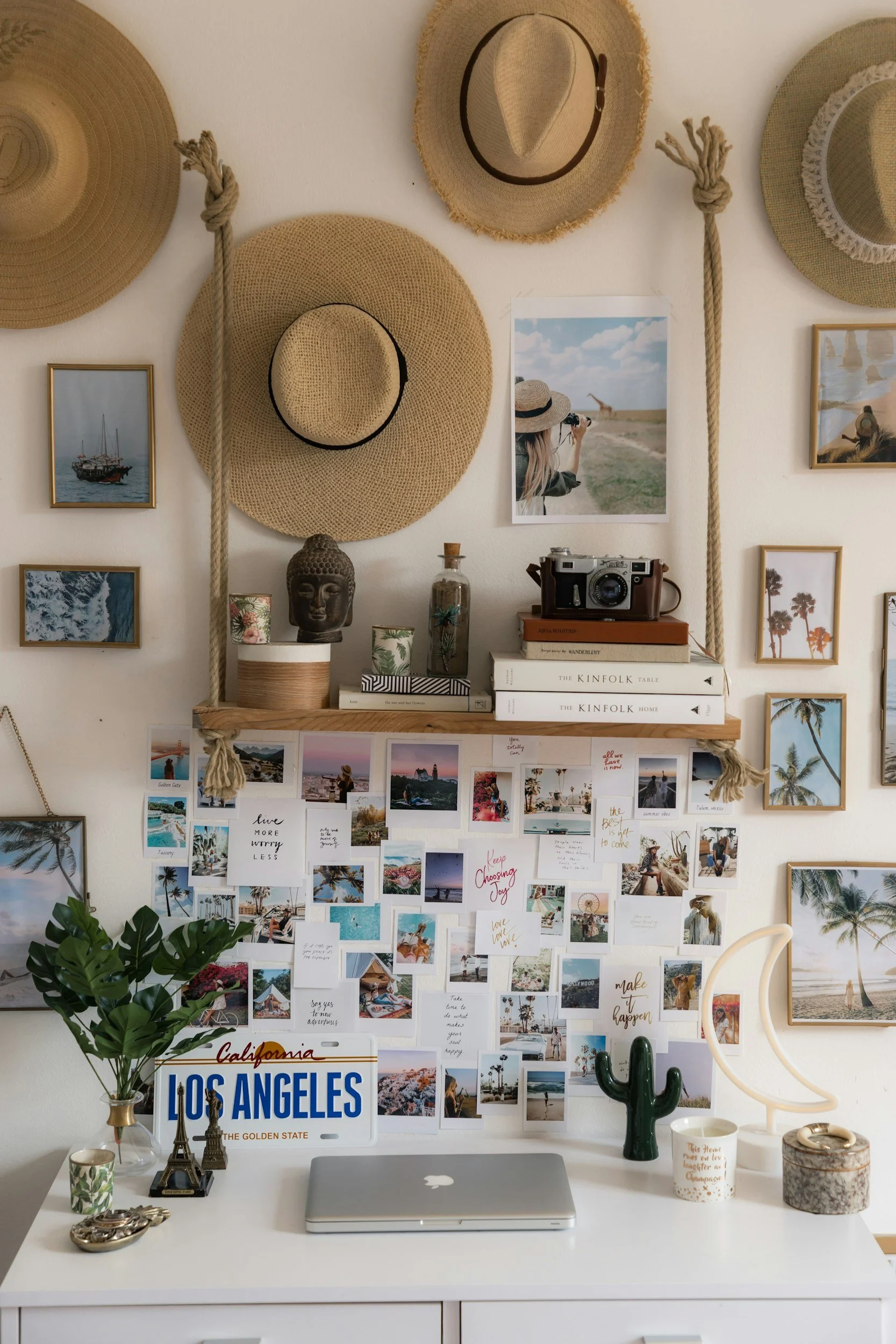
I’ve also been using Canva to create virtual vision boards incorporating images from nature.
Rather than focusing only on traditional goal-setting, these vision boards can become a visual exploration of what someone wants to feel, experience, or move toward.
A client might choose images that represent:
Growth.
Peace.
Freedom.
Connection.
Strength.
Rest.
Adventure.
Belonging.
Change.
The images become prompts for conversation.
Why did you choose this image?
What does it represent to you?
What feeling comes up when you look at it?
What would it look like to bring more of this into your life?
Sometimes an image communicates something that is difficult to put into words.
And sometimes seeing those images together helps a client recognize a pattern they hadn't noticed before.
Using Nature to Explore Anxiety
I’ve also been incorporating ideas from Dr. Heidi Schreiber-Pan’s book, Taming the Anxious Mind: A Guidebook to Relieve Stress and Anxiety, into my work around anxiety. Dr. Schreiber-Pan is a psychotherapist, author, and researcher whose work includes anxiety, resilience, and nature-based mental health.
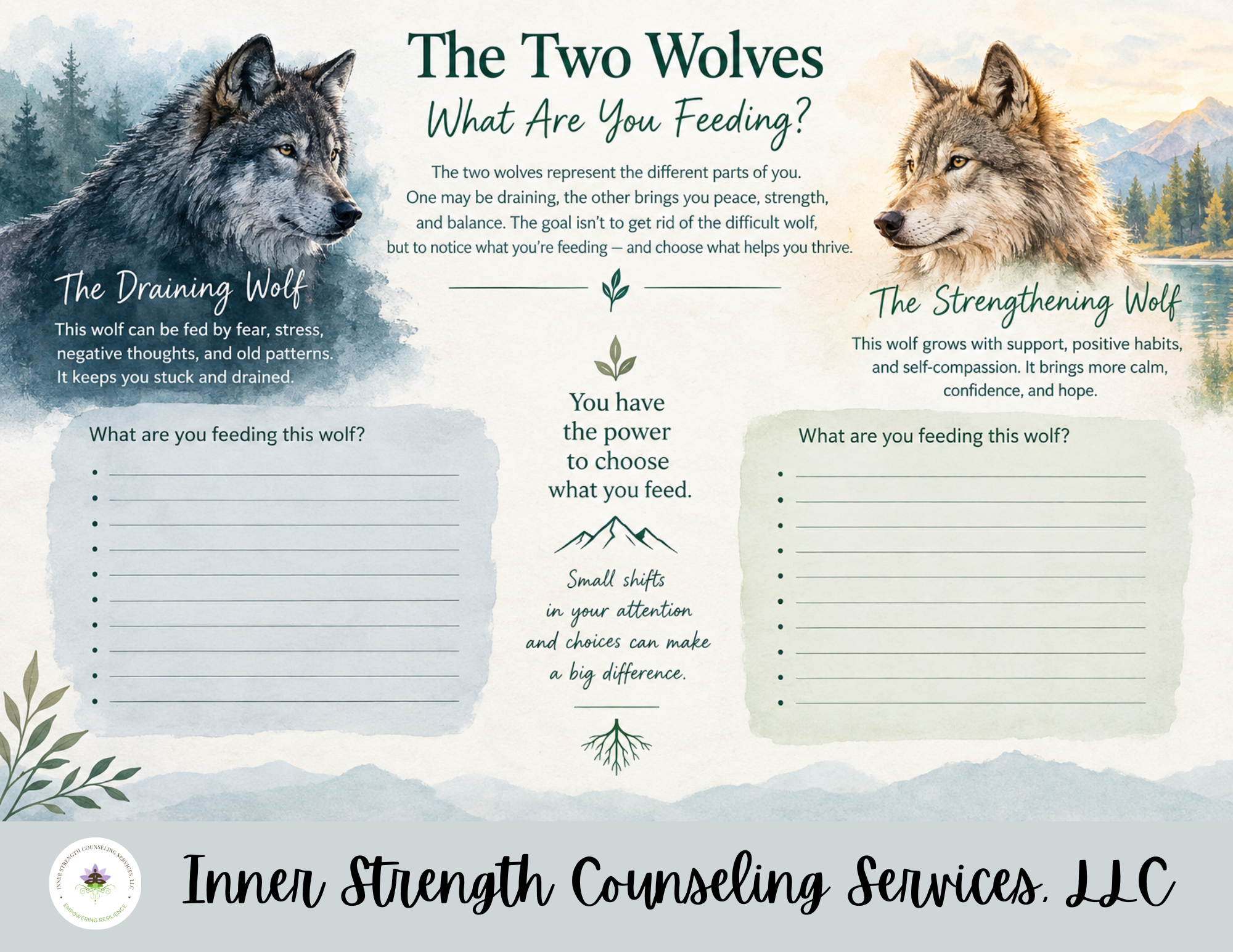
One exercise I’ve adapted is inspired by the familiar "two wolves" parable.
I invite the client to draw two wolves.
One wolf represents the emotional state or pattern that is draining them — the thoughts, behaviors, fears, or habits that continue to feed that experience.
The other wolf represents the emotional state they want to strengthen — perhaps peace, confidence, hope, self-compassion, or calm.
Then we explore:
What are you feeding each wolf?
Clients can write inside or around each wolf the things that contribute to that emotional state.
For example, one wolf might be fed by:
Negative self-talk.
Avoidance.
Overthinking.
Comparison.
Perfectionism.
Constant worry.
The other might be fed by:
Rest.
Connection.
Boundaries.
Self-compassion.
Movement.
Time in nature.
Supportive relationships.
Mindfulness.
The goal isn't to pretend the difficult wolf doesn't exist.
We aren't trying to eliminate anxiety, sadness, anger, or fear.
Instead, we're becoming more aware of what we are repeatedly giving our attention and energy to.
Then we can begin asking:
What can I do differently to feed the wolf I want to strengthen?
This is where the exercise becomes more than a drawing.
It becomes a visual representation of choice, attention, and intentional action.
Bringing Nature Into Grief Work
Not all of my nature-informed work happens outdoors.
One example is the grief work I’ve been doing virtually.
I have been using Canva to create visual exercises that incorporate photographs and images from nature. These images become invitations for reflection, storytelling, memory, and meaning-making.
For grief work, an image can sometimes help a person access emotions or memories that are difficult to reach through conversation alone.
A photograph of a trail might represent a journey.
A changing season might reflect a transition.
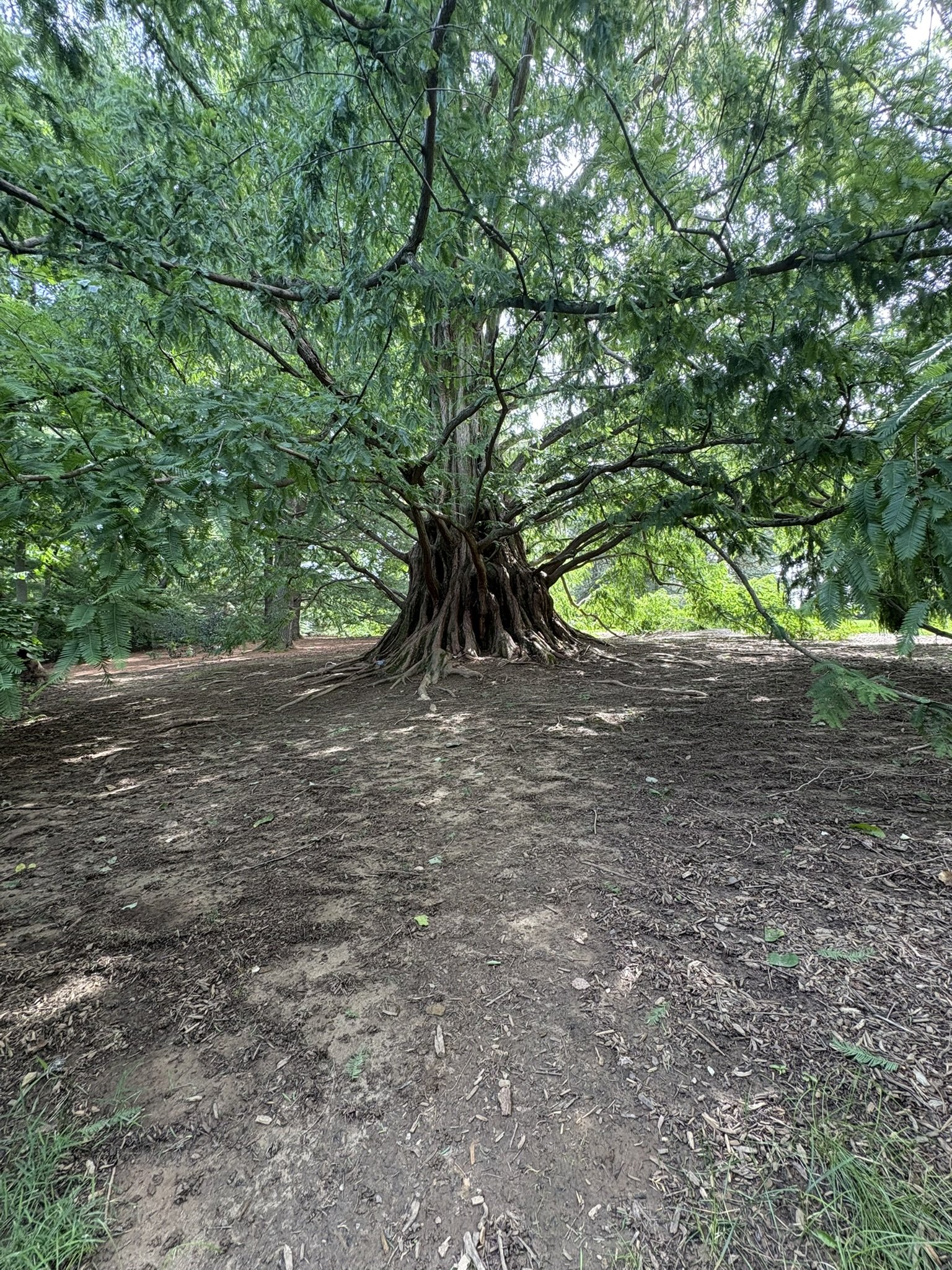
A tree standing through different seasons might represent endurance.
A landscape might bring up a memory of someone who has died or a place that holds meaning.
The image itself isn't necessarily the intervention.
It becomes a doorway into the therapeutic conversation.
I might ask:
"What does this image bring up for you?"
"What do you notice first?"
"What does this image remind you of?"
"If this image represented part of your grief journey, what part would it represent?"
"What meaning does this image hold for you?"
This has reminded me that nature can enter the therapeutic space through images, memories, metaphors, stories, and reflection.
We don't always have to physically step outside for nature to become part of the conversation.
What I’m Learning Along the Way
One of the biggest lessons I've learned since beginning this work is that Nature-Informed Therapy isn't about finding the "perfect" intervention.
It is about curiosity.
It is about paying attention to the person in front of me and considering how nature might support the work we are already doing together.
Sometimes that means walking.
Sometimes it means sitting.
Sometimes it means noticing a bird.
Sometimes it means using a photograph of a landscape during a virtual session.
Sometimes it means creating a vision board filled with images that represent what someone wants more of in their life.
Sometimes it means drawing two wolves on a digital canvas and exploring what we're feeding with our thoughts, behaviors, and choices.
Sometimes it means asking questions about someone's relationship with nature and discovering that the natural world has been part of their identity all along.
And sometimes it means simply creating enough space for someone to notice what is happening within them.
Nature Isn't Always the Setting — Sometimes It's the Invitation
As I continue growing as a Nature-Informed Therapist, I find myself becoming less focused on having a long list of techniques and more interested in developing the ability to notice.
What is the client noticing?
What is their body communicating?
What does the environment offer us today?
What metaphor is emerging?
What does this image bring up?
What relationship does this person have with the natural world?
Where might there be an opportunity for curiosity?
Sometimes nature is physically around us.
Sometimes it enters the session through an image.
Sometimes it appears through a metaphor.
Sometimes it becomes a question.
And sometimes it simply reminds us to slow down.
That, for me, is part of what makes Nature-Informed Therapy so meaningful.
It isn't simply therapy outside.
It is an intentional way of inviting the natural world into the therapeutic process.
I’m still learning.
I'm still experimenting.
And every session teaches me something new.
Sometimes it teaches my clients.
Sometimes it teaches me.
And sometimes, if we are paying close enough attention, the trail—or even an image of a trail—teaches us both.
A Note About Nature-Informed Therapy
Nature-Informed Therapy is not about needing to be an experienced hiker, athlete, or "outdoorsy" person.
It can look different for every person.
A session might involve walking, sitting, sensory awareness, mindfulness, grounding, nature-based imagery, visual exercises, reflection, or simply exploring someone's relationship with the natural world.
The goal is not to perform outdoors.
The goal is to create a therapeutic environment where you can slow down, connect, and explore what matters.
Nature can be part of the therapy room, part of a virtual session, or part of an outdoor experience.
There is no single way to do Nature-Informed Therapy.
And I think that's part of its beauty.
Resource Mentioned
Schreiber-Pan, H. (2019). Taming the anxious mind: A guidebook to relieve stress and anxiety. Chesapeake Publication.
Dr. Schreiber-Pan's work can be found at heidischreiberpan.com.